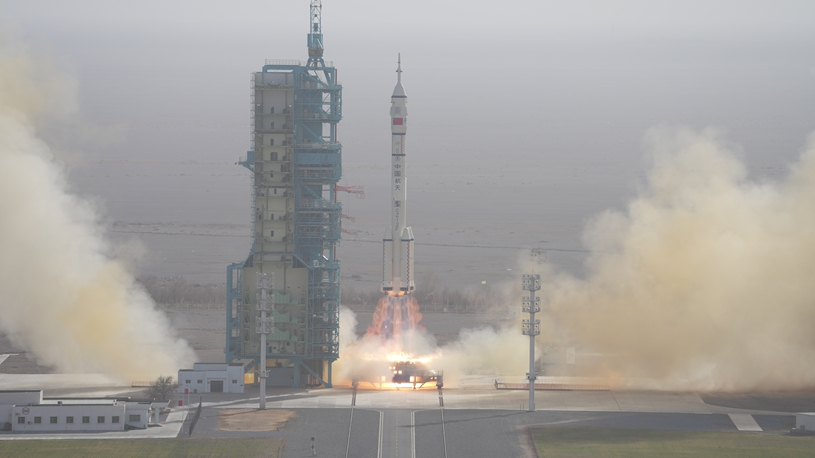
Credit: China Academy of Launch Vehicle Technology
In a critical operation, China launched the Shenzhou 22 spacecraft on November 14, 2025, from the Jiuquan Satellite Launch Center to serve as an emergency lifeboat for three astronauts stranded on the Tiangong space station. The launch was necessitated by damage to one of the crew ferry ships, Shenzhou 20, which was compromised after being hit by space junk, debris in low-Earth orbit that poses a significant threat to operational spacecraft.The Shenzhou 22 spacecraft was launched aboard a Long March 2F rocket, demonstrating China's reliable launch capabilities and its commitment to ensuring the safety of its astronauts. The Tiangong space station, China's premier orbital outpost, has been continuously occupied by Chinese astronauts since its inception, with regular crew rotations facilitated by the Shenzhou spacecraft series.
The concept of a lifeboat or emergency rescue vehicle is not unique to China's space program; the International Space Station (ISS), a collaborative project between space agencies including NASA, ESA, and others, also employs a similar strategy. For instance, SpaceX's Dragon spacecraft and the Russian Soyuz crew ships serve as crew ferry vessels for ISS astronauts, providing a safe means of transportation to and from the station. In the event of an emergency, these vehicles can also function as lifeboats, underscoring the importance of redundancy in space mission planning.
China's human spaceflight program has demonstrated remarkable consistency and reliability since its inaugural mission in 2003. With missions like Shenzhou 5, which marked China's first manned spaceflight, the country has steadily advanced its capabilities, culminating in the development of the Tiangong space station. This latest launch highlights China's ability to respond effectively to unforeseen challenges, a crucial aspect of long-duration spaceflight.
The significance of this event extends beyond the successful rescue of the astronauts; it also underscores the broader implications for space safety and mission planning. As more countries and private entities engage in space exploration, the risk posed by space junk will continue to grow. Therefore, developing strategies to mitigate these risks, including the implementation of emergency rescue protocols, will become increasingly important.
In conclusion, China's launch of the Shenzhou 22 spacecraft as an emergency lifeboat for stranded astronauts on the Tiangong space station is a testament to the country's technological prowess and its dedication to space exploration. This event serves as a reminder of the complexities and challenges inherent in human spaceflight and highlights the need for continued innovation and cooperation within the global aerospace community to ensure safe and successful missions.