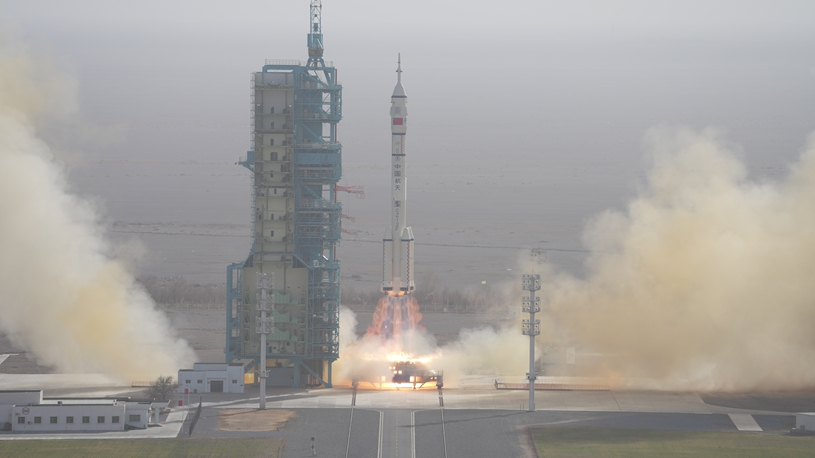
Credit: China Academy of Launch Vehicle Technology
On November 25, 2023, the Shenzhou-22 spacecraft successfully docked at China"s Tiangong space station, reestablishing a vital lifeboat for the crew and ending the orbital outpost"s first operational emergency. The Shenzhou-20 spacecraft, which was previously docked at the Tiangong space station, suffered damage from a suspected space debris impact, prompting concerns about the safety of the crew and the continued operation of the space station.The Shenzhou-22 spacecraft was launched from the Jiuquan Satellite Launch Center on November 24, 2023, aboard a Long March 2F rocket. The spacecraft carried cargo instead of a crew, highlighting the flexibility and adaptability of China"s space program. The successful docking of the Shenzhou-22 spacecraft at the Tiangong space station demonstrates the reliability and efficiency of China"s human spaceflight capabilities.
One of the key features of the Shenzhou-22 spacecraft is its improved human-machine interface, which enhances the interaction between the crew and the spacecraft systems. Additionally, the spacecraft is equipped with a miniaturized instrument panel, which provides critical information to the crew in a compact and efficient manner. These technological advancements reflect China"s commitment to developing cutting-edge space technologies and ensuring the safety and effectiveness of its space missions.
The Tiangong space station, which consists of the Tianhe core module and other components, is a critical part of China"s space program. The space station is designed to be permanently crewed for at least a decade, with the goal of conducting scientific research, testing space technologies, and demonstrating the capabilities of China"s space program. The successful docking of the Shenzhou-22 spacecraft ensures the continued operation of the Tiangong space station and marks a significant milestone in China"s efforts to establish a sustainable human presence in space.
The significance of this event extends beyond China"s space program, as it highlights the importance of international cooperation and collaboration in addressing the challenges of space exploration. The risk of space debris impacts is a concern for all space-faring nations, and the successful response to this emergency demonstrates the value of investing in robust and reliable space technologies. As the global space community continues to push the boundaries of space exploration, the lessons learned from China"s experience with the Shenzhou-22 spacecraft and the Tiangong space station will be invaluable in shaping the future of human spaceflight.