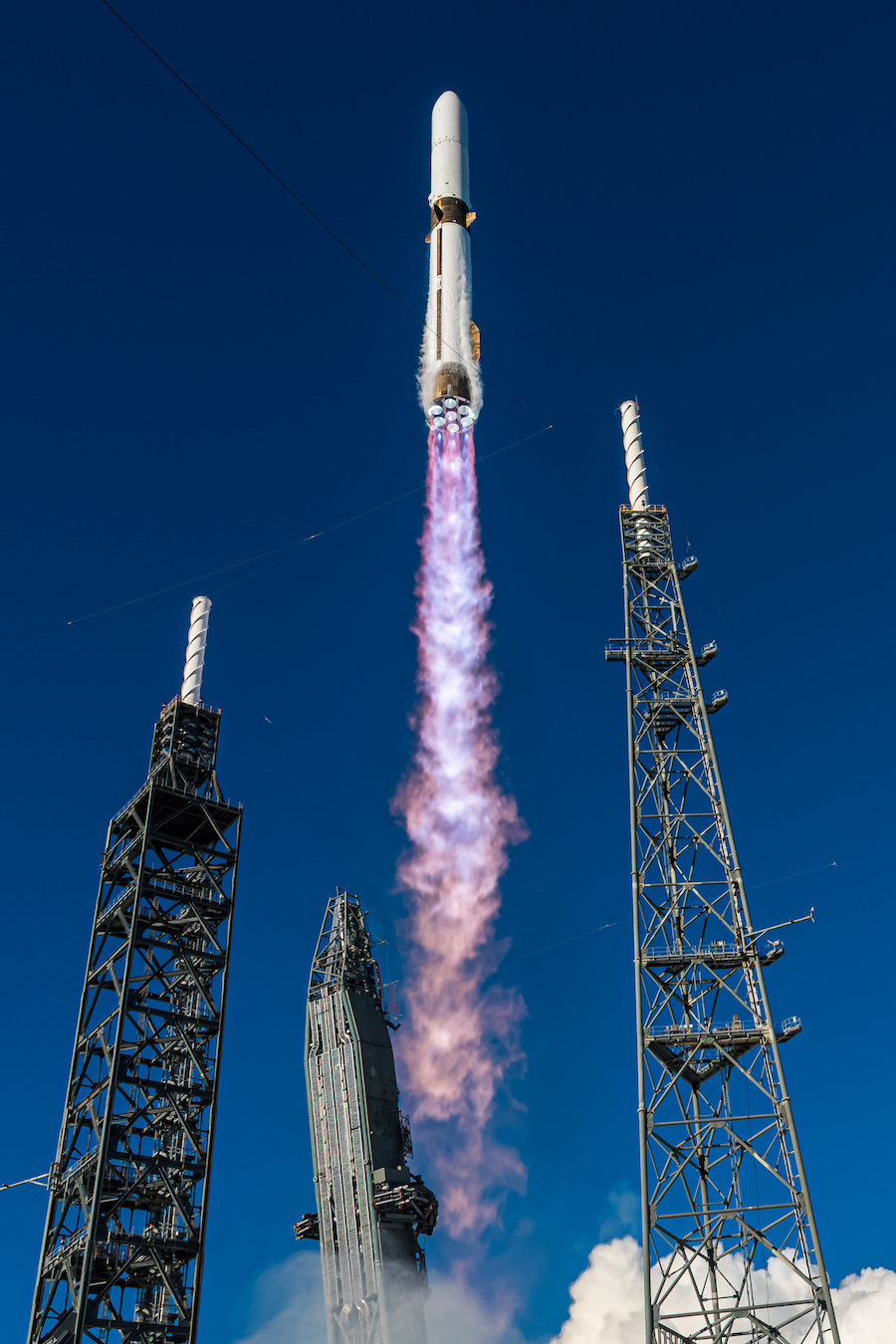
Photo courtesy of Blue Origin, LLC
Blue Origin has reached a major milestone with the successful launch and recovery of its New Glenn rocket, the company"s second orbital vehicle. The mission, which took place in 2025, demonstrated the rocket"s capability to reach orbit and return its booster to Earth, landing it safely on a barge named Jacklyn. This achievement is a significant step forward for Blue Origin as it works to increase production and meet the high demand for launches.From a technical standpoint, the New Glenn rocket utilizes a methane propellant, which offers several advantages over traditional kerosene-based fuels, including a cleaner burn that does not produce soot. The rocket is powered by a combination of BE-4 rocket engines and BE-3U engines, providing the necessary thrust to reach orbit. The second stage of the New Glenn, internally referred to as GS-2, plays a critical role in achieving orbital velocities and deploying payloads.
The success of the New Glenn launch and recovery is a testament to Blue Origin"s commitment to developing reusable rockets, which are expected to significantly reduce the cost of access to space. By recovering and reusing its boosters, the company can minimize the expense associated with producing new rockets for each mission, making space travel more efficient and affordable. This approach has far-reaching implications for the aerospace industry as a whole, enabling more frequent and cost-effective launches that can support a wide range of applications, from satellite deployment to lunar exploration.
Looking ahead, Blue Origin plans to fly the New Glenn rocket more frequently, with its next payload scheduled to be the Blue Moon Mark 1 lunar lander. This mission will mark an important step in the company"s ambitions to establish a human presence on the Moon and eventually send crewed missions to other destinations in the solar system. As the demand for launch services continues to grow, driven by the expanding commercial space industry and government agencies" increasing reliance on private sector providers, Blue Origin is well-positioned to play a leading role in meeting this demand and pushing the boundaries of space exploration.
The significance of Blue Origin"s achievement extends beyond the company itself, as it contributes to the ongoing evolution of the aerospace industry. The development of reusable rockets like New Glenn is driving innovation and competition, encouraging other companies to pursue similar technologies and business models. As a result, the cost of access to space is decreasing, enabling new opportunities for scientific research, commercial activity, and exploration. With its successful launch and recovery of the New Glenn rocket, Blue Origin has demonstrated its commitment to this vision and its role as a leader in the rapidly advancing field of private spaceflight.